LEGAL UPDATE · SEPTEMBER 2026
On August 31, 2026, President José Raúl Mulino signed Law 546 of 2026 into law, restoring important relief from Panama’s Real Estate Transfer Tax (Impuesto de Transferencia de Bienes Inmuebles, or ITBI) for qualifying first sales of new homes. The Law took effect on September 1, 2026.

It was published in Official Gazette No. 30601-B on Monday, August 31, 2026.
The reform is an important development for Panama’s residential real estate market. It reduces the transfer-tax burden associated with qualifying newly built homes, supports access to housing and may encourage new construction and mortgage activity.
Important distinction: the Law applies to the first sale of a new dwelling. It does not state that the purchaser must be buying a home for the first time.
What Law 546 Changes
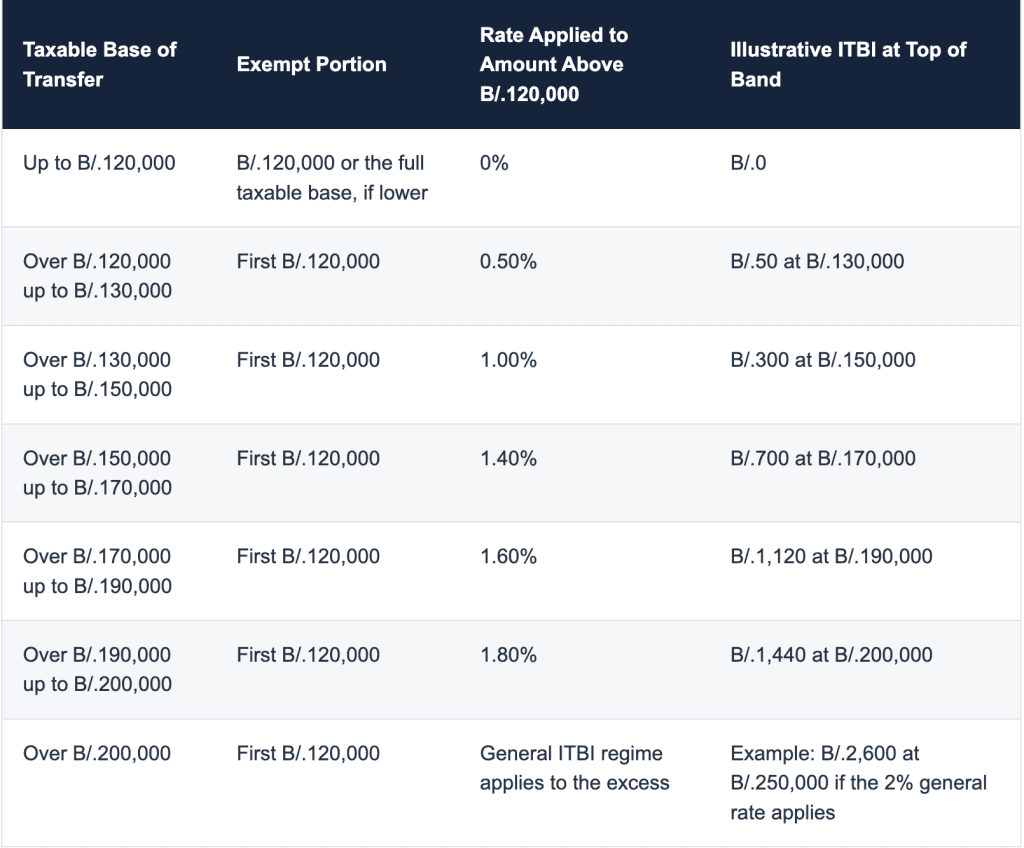
Law 546 amends Article 4 of Law 106 of 1974. For a qualifying transaction, the first B/.120,000 of the taxable base is exempt from ITBI. The normal transfer-tax rate is 2%, but preferential rates apply to the portion above B/.120,000 when the total taxable base is more than B/.120,000 and no more than B/.200,000.
ITBI Rates and Key Amounts

WILLIAMS & ASSOCIATES
Law 546 focuses on a qualifying property’s first sale as a new dwelling—not on whether the buyer has owned a home before.
Conditions for the Benefit
The exemption is not automatic for every residential purchase. The transaction must satisfy the Law’s requirements, including the following:
- The property must constitute a new dwelling.
- The transfer must be the property’s first sale.
- As a general rule, the sale must be formalized within two years after the competent authority issues the occupancy permit.
- The seller must state under oath in the public deed that the statutory conditions are met and include the date and identifying information of the occupancy permit.
- The exemption must be reported to Panama’s tax authority, the Dirección General de Ingresos (DGI), through the mechanism it establishes.
A prior DGI certificate excluding the transaction from ITBI is not required under the Law. However, an incorrect sworn statement or improper use of the exemption may lead to payment of the unpaid tax, surcharges, interest and other applicable sanctions.
The Law also contains a transitional rule. A qualifying first sale formalized after the Law took effect may benefit even if its occupancy permit was issued earlier, provided the sale occurs within 30 months after the permit was issued and all other conditions are met.
Why This Matters to Expatriates and Foreign Buyers
Law 546 can be relevant to expatriates and foreign nationals who are relocating to Panama and considering a newly built residence. This may include individuals pursuing permanent residence through the Pensionado program or through a qualifying investment-based immigration category.
The statutory benefit is framed around the property and the transaction: a new dwelling, its first sale, the applicable taxable base and the timing of the occupancy permit. The Law does not present the exemption as an immigration benefit or expressly condition it on the purchaser’s nationality.
For international clients: purchasing a home and applying for residence are separate legal processes. A property that qualifies for ITBI relief will not necessarily qualify as an investment for immigration purposes, and the exemption does not itself grant or guarantee Panamanian residence.
Nevertheless, for foreign buyers already planning to acquire a qualifying newly built home, the reform may reduce the transfer-tax amount associated with the transaction. It also makes careful pre-closing review especially valuable: counsel should verify the property’s status, occupancy-permit date, taxable base, first-sale history, deed language and the seller’s compliance obligations.

Who Is Legally Responsible for the ITBI?
Although the exemption can affect the economics of a purchase, the ITBI is legally the seller’s obligation. Law 546 expressly provides that any contractual term requiring the buyer to pay, reimburse or assume ITBI that legally belongs to the seller is null and void.
Buyers should therefore examine reservation agreements, promises to purchase, closing statements and public deeds to ensure that the tax is not improperly shifted to them.
Practical Steps Before Signing
- Confirm that the unit is legally classified as a new dwelling and that the transaction is its first sale.
- Obtain and review the occupancy permit and its issuance date.
- Confirm the taxable base used for the ITBI calculation rather than relying only on the advertised price.
- Review the contract and closing statement for any clause that attempts to transfer the seller’s ITBI obligation to the buyer.
- Evaluate the real estate purchase separately from any Pensionado or investment-based residence application.
- Coordinate legal, tax, banking and immigration advice before funds are committed.
Planning to Buy a New Home in Panama?
Our firm can review the proposed transaction, confirm whether the statutory conditions appear to be met, examine the purchase documents and coordinate the real estate process with your immigration strategy. Contact us before signing a reservation agreement or promise to purchase.